MCHM ’26 — The 3rd International Workshop on Multimedia Computing for Health and Medicine, co-located with ACM Multimedia 2026 · November 10–14, 2026 · Rio de Janeiro, Brazil
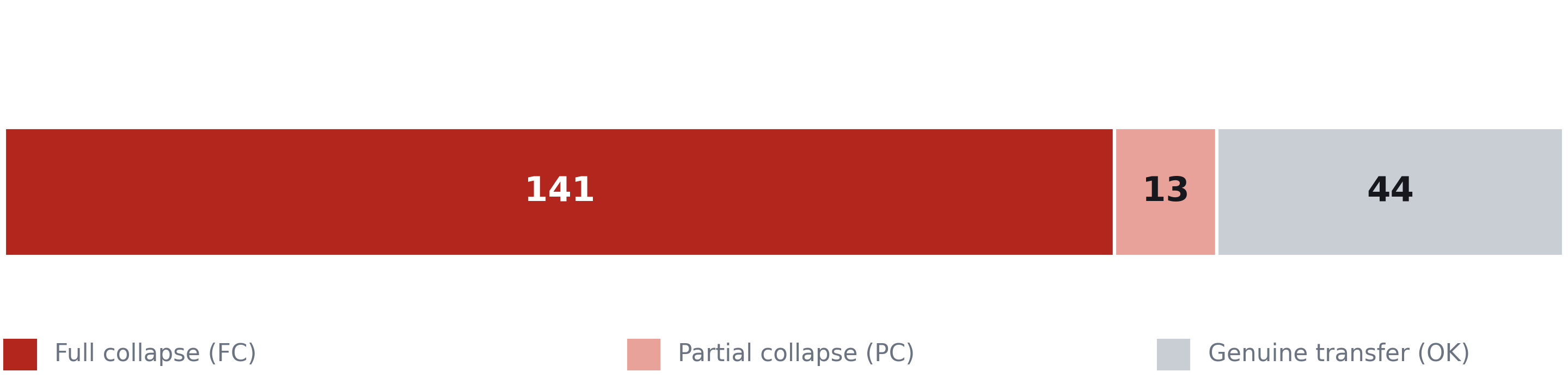
Skeleton-based models for exercise quality assessment score well when trained and tested on the same recording setup, but it is unclear whether they hold up once deployment moves across laboratory, clinical, motion-capture, and web-video domains. We benchmark this question directly: 4 exercise datasets, 9 skeleton-based models spanning GCN and transformer architectures, and 198 out-of-distribution transfer experiments. The result is that 154 of 198 OOD experiments (77.8%) exhibit full or partial classifier collapse — the model settles on one class almost regardless of input, a failure that overall accuracy and macro-F1 do not reveal on their own.
Overview
Cross-Domain Exercise Quality Assessment
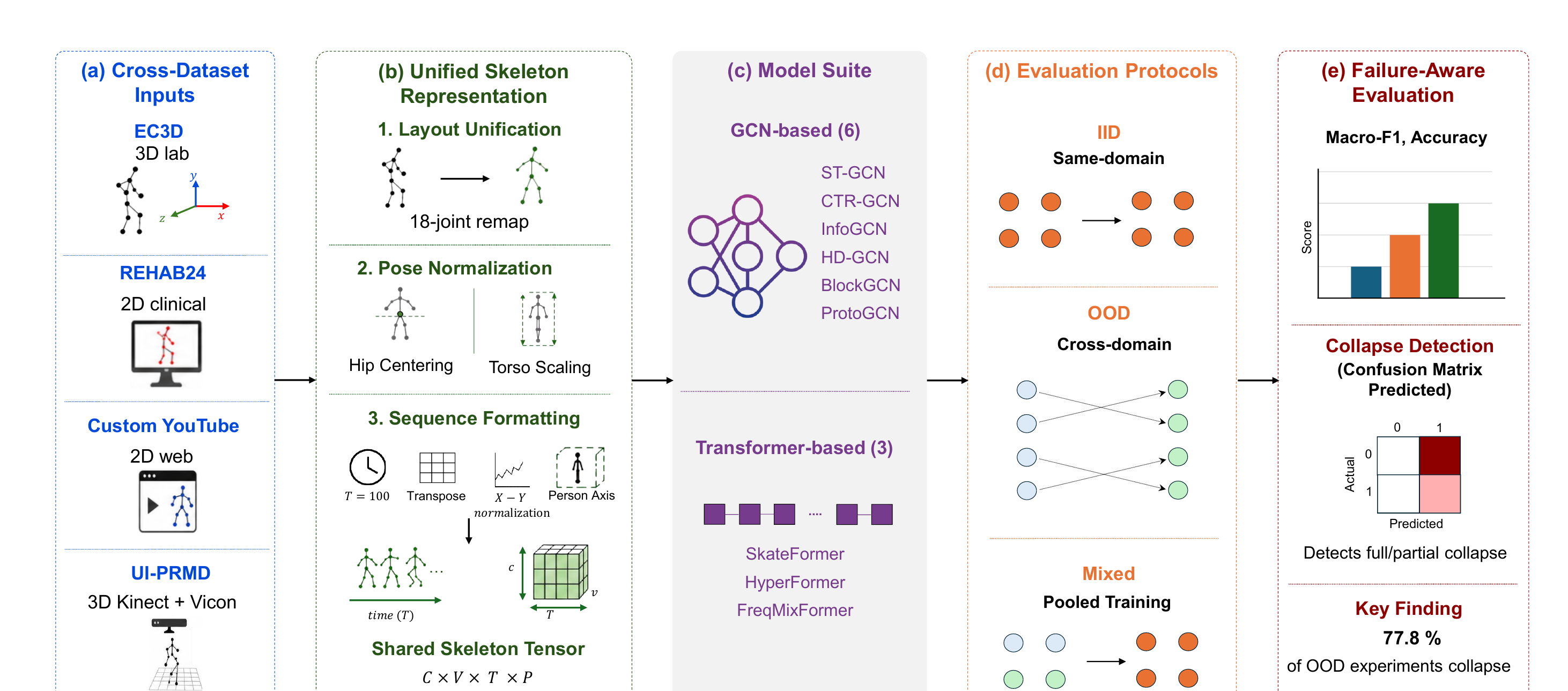
Four datasets — EC3D, REHAB24, Custom YouTube, and UI-PRMD — are unified under one 18-joint preprocessing protocol, evaluated across nine skeleton models, and scored with a failure-aware protocol that inspects per-class prediction counts rather than aggregate accuracy alone.
Main Result
Cross-Domain Collapse Is the Main Failure Mode
77.8%
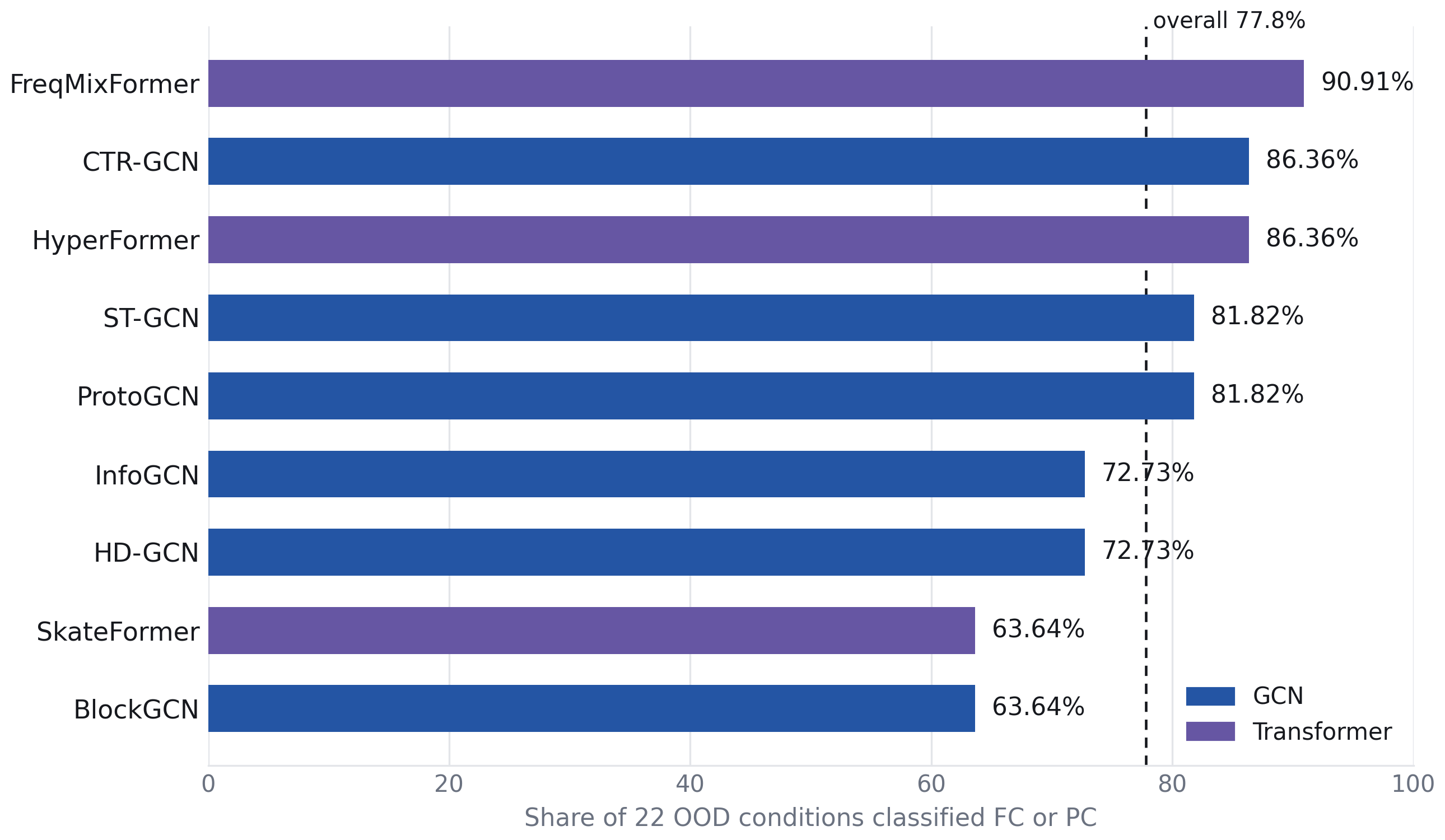
154 of 198 OOD transfer experiments exhibit full or partial classifier collapse.
Full Collapse (FC)One class receives zero predictions across the entire test set.
Partial Collapse (PC)One class receives five or fewer predictions — at most ~3.6% class coverage.
A model can report a non-zero F1 score while effectively predicting almost every sample as the same class.
Architecture Comparison
Newer Architectures Do Not Solve Domain Shift
GCN · 6 models
ST-GCN
CTR-GCN
InfoGCN
HD-GCN
BlockGCN
ProtoGCN
Transformer · 3 models
SkateFormer
HyperFormer
FreqMixFormer
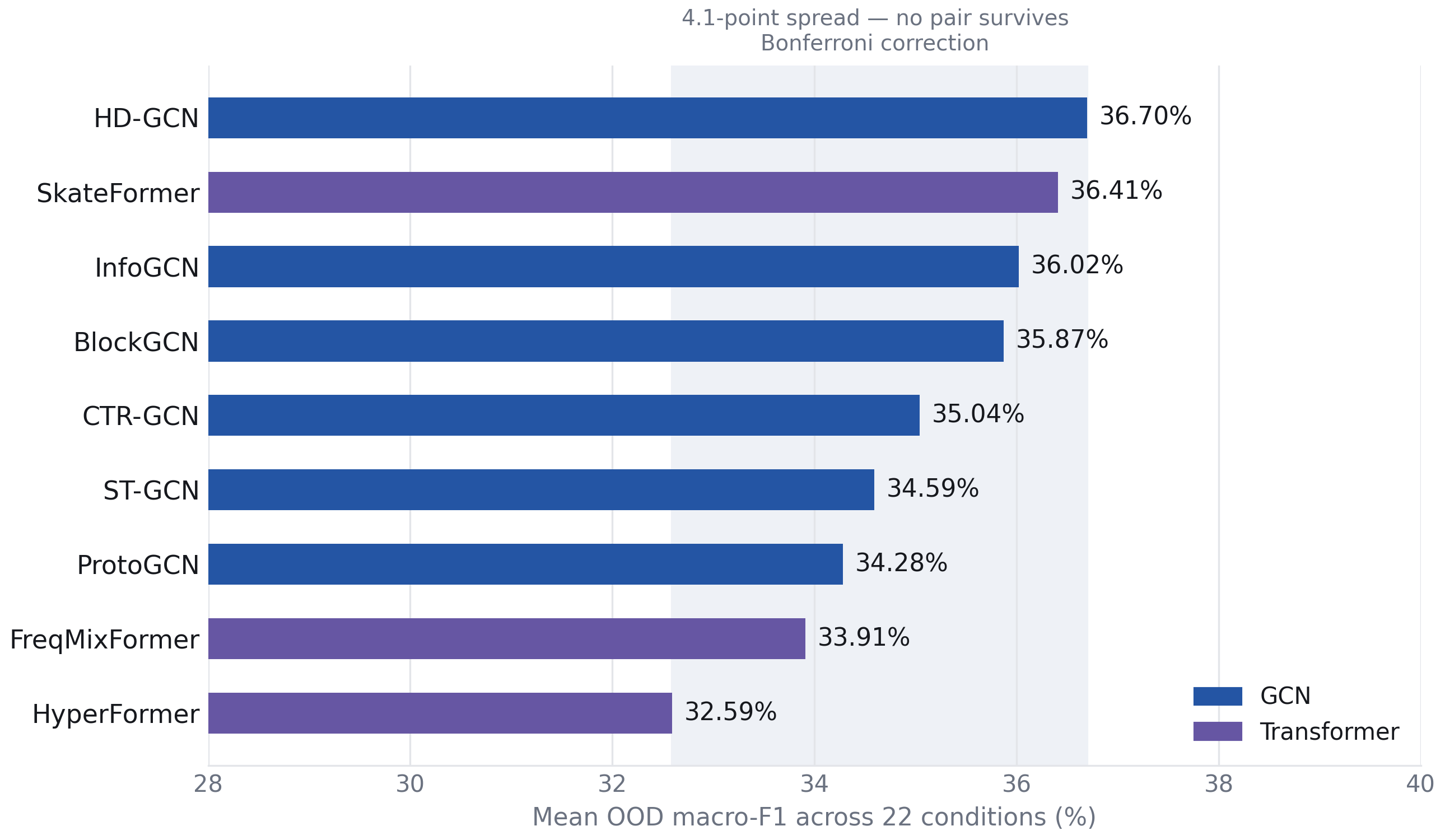
Mean OOD macro-F1 clusters tightly across all nine models — 32.6% to 36.7%. Only 1 of 36 pairwise comparisons is significant before correction, and none remain significant after Bonferroni correction. All experiments are single runs (seed 42), so the results are exploratory.
Architecture family alone does not reliably predict cross-domain robustness.
Pooled Training
Data Diversity Helps — But It Is Not Unseen-Domain Generalization
0
collapsed models in Mixed D1
91.4%
best result — InfoGCN
4
domains pooled in training
Mixed D1 pools data from all four domains before splitting into train / val / test, so it should not be read as generalization to an unseen domain — it shows the task is learnable given broad coverage, not that transfer to a truly novel recording environment is solved.
Citation
BibTeX
@inproceedings{10.1145/3840471.3842592,
  author    = {Vahdati, Monica and Gholizadeh HamlAbadi, Kamran and Etemad, Ali and El Saddik, Abdulmotaleb},
  title     = {Skeleton-Based Exercise Quality Assessment Under Domain Shift: A Benchmark Study of Cross-Domain Failure Modes},
  year      = {2026},
  isbn      = {9798400729256},
  publisher = {Association for Computing Machinery},
  address   = {New York, NY, USA},
  url       = {https://doi.org/10.1145/3840471.3842592},
  doi       = {10.1145/3840471.3842592},
  booktitle = {Proceedings of the 3rd International Workshop on Multimedia Computing for Health and Medicine},
  pages     = {43--52},
  numpages  = {10},
  location  = {Rio de Janeiro, Brazil},
  series    = {MCHM '26}
}